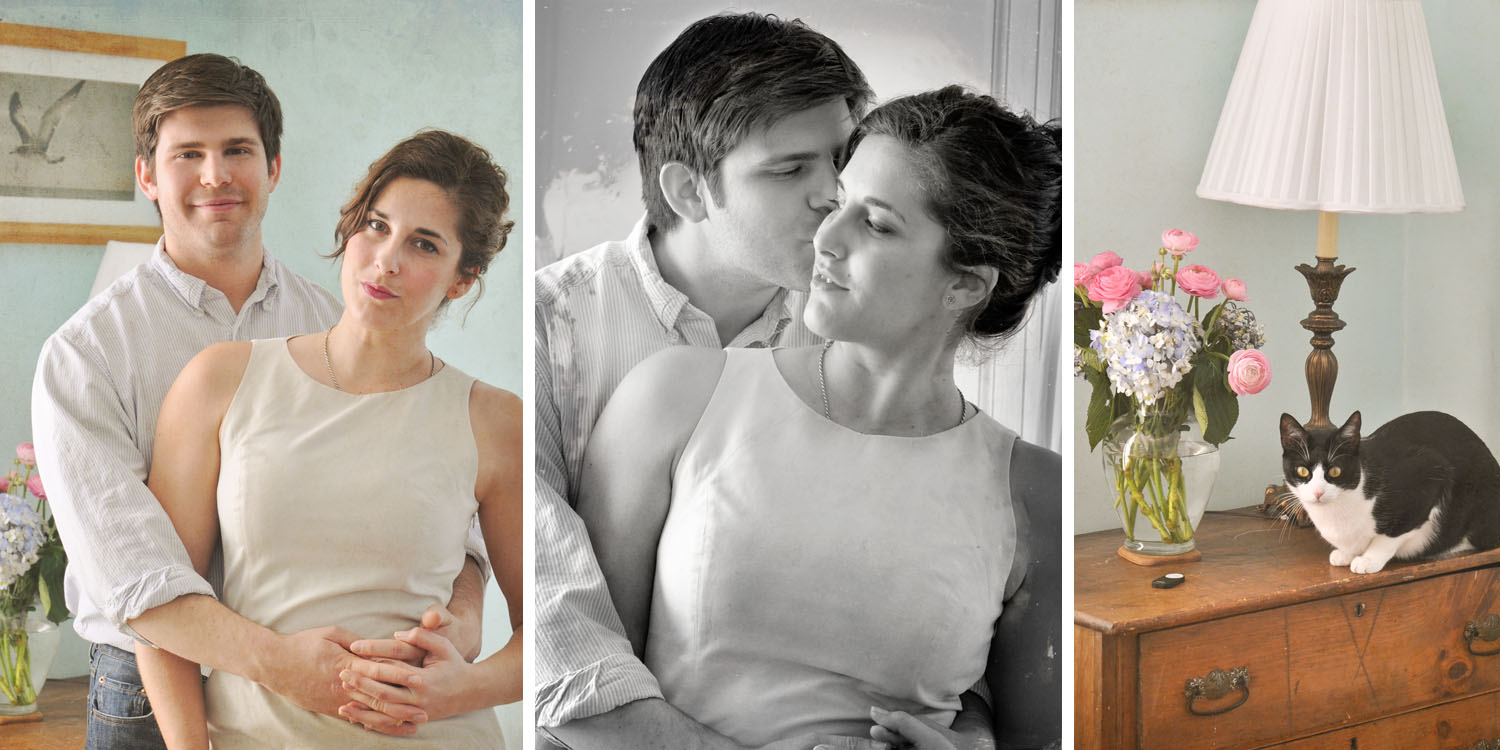
In Response and In Defense

I’ll be honest. I got one really bad grade in college.

Psych 1 marched me right on down the alphabet, all the way to a C. As in, Can you believe I got a C in the class that we as humans, witnessing and expressing thoughts and behavior daily, may actually have a basic knowledge of? Scratch that- I may have just barely gotten a C. It may have been a C minus. I can’t remember. As we learned in Pysch 1, our brain occasionally protects itself from things we can’t handle by masking a traumatic memory.
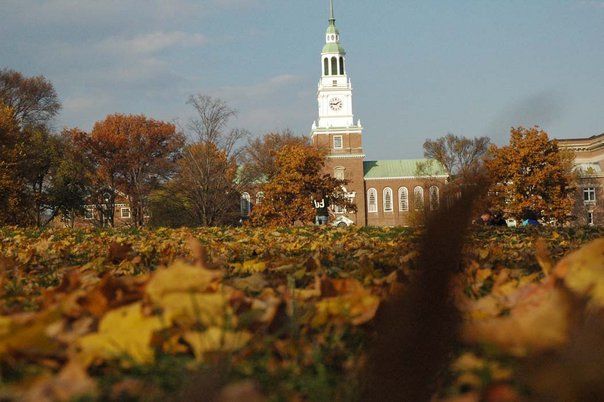
dartmouth
Photo credit: Teresa Forster

The New York Times recently reported that Dartmouth College, my alma mater, is no longer accepting high school AP credit due to its curriculum not meeting college standards. Dartmouth came to the conclusion after slapping together an experiment of seeing how many incoming freshmen, having scored a 5 on their Psych AP test, could pass the Psych 1 final at Dartmouth. Turns out 90% failed. So, according to the article, Dartmouth is chucking all AP credits and will no longer turn your AP 4 or 5 scores into college credit.

I see no issue with not taking AP credit, because over a four year span, there is plenty of time to amass the necessary credits to graduate without walking in with eight credits already under your belt. A triple major balanced with varsity athletics may be more difficult, but I think work/life balance is still the name of the game. And I believe that Dartmouth still allows you to test out of some classes, like language courses. Dartmouth’s unique mandatory language requirement is superfluous for some.

However, the point of this so far senseless exposé is to point out the obvious flaw in this so called experiment. It’s so obvious, that I almost doubt the reporting of the article.

What does a good teacher or professor do when everyone in their class fails a test? They at least consider the option that they made a bad test or that they somehow failed to deliver the information. I believe this is the base theory behind the idea of grading on a ‘curve.’

I took Psych 1 at Dartmouth my freshmen year, when, as a younger and less jaded student, I was entertaining thoughts of becoming a psych major- nay- thoughts of becoming a world renowned author exposing the truths and intricacies of human behavior. Since I began this article with a scathing truth, I’ll continue the theme and confess that even though I had the best of intentions, I wasn’t the best of students. I never missed a class and listened to lectures with the utmost care and took full pages of notes (with only the occasional doodle), but I was hopeless about completing the assigned readings. For the most part, I gave the class as much attention as my others and did make my way through most of the readings, but I often found myself struggling to commit every line into a memory or fact. I was dutiful in my reading notes and they were mostly reinforced by the lectures, but I knew I was struggling. There’s a reason why we don’t all just read books and become masters of a subject. If that was the case, we wouldn’t need teachers, just writers. I’m the first to recognize the godly power of a talented writer, but I also recognize that teachers can be a far better and dynamic instrument than lines on paper. So, in most classes, when I struggled with the reading, it was ok because the class itself would get me through the material.

I didn’t know I was struggling that bad until I saw my first test score. The professor would post all 100 or so student test results just outside the class door, using the anonymity of our student IDs. They were listed in order of highest to lowest grade. My assigned number almost had me on my knees, not just to beg for mercy, but because my score was so far down.

The class was uniquely structured in that it had four rotating professors, evenly divided over the term and each specializing in a specific topic. At the end of each quarter, the professor gave a multiple choice test. Every class was the same with a lecture and assigned reading. Turns out every test score of mine was also the same, despite the crummy grades prompting a greater drive. I wasn’t alone in my inaptitude and heartbreak. Many fellow students were in the same (sinking) boat. Well, besides one of my good friends. (She aced every test. But it wasn’t fair, because she’s a genius and all.) I later learned the class was referred to as a “weeder”: one designed to “weed” out students who didn’t yet know that they didn’t really want to be a psych major. Well, I was soon to be “pulled” out of my preconceived notions, and replanted in the art department. I’m not sure what the strongest cause was- the teaching, class structure,  my work ethic, or just the test itself, but I, along with a good portion of the class, was struggling to keep my head above water.

I was so desperate to boost my grade- and I was only a measly freshmen, that I was the first to sign up as a test subject when they announced that students could get extra credit by volunteering in graduate student experiments. I was facing the threat of a grade that I’ve never had to think about before and it drove me straight into a room with four white walls. Most of the experiments were harmless and worth the time, although I have no idea how answering random questions about “What photo do you find more attractive: A or B?” could bestow me with knowledge that the professors were tasked with delivering. The only experiment that I found jarring and a tinge scary was having to complete a series of tests inside a CT. I discovered that day that I may be mildly claustrophobic and developed a paranoia that somewhere on my body, there may indeed be metal lodged. I mean, how can we be sure- and we can’t be too sure, before lying inside a giant spinning magnet? It was supposed to be a two-part experiment, but thankfully the CTG scanner mysteriously broke the next day.

Case in point, Pysch 1 left me jaded and running for the hills. I threw out all hopes of furthering an academic career in the subject matter and spent the rest of my four years trying to boost my GPA. It’s ok, I’m really not one to give grades total mental authority, but it bugged me that my increased efforts in the class never affected my test results. I guess you could argue that Psych 1 bestowed a more useful set of skills, teaching me that college ain’t no joke and leading me on to subject matters that I could actually excel in. Well, I shouldn’t get carried away. A “B” may be the bees-knees when you were dreading a “D”, but it’s not exactly acing a matter, either.

baker tower
Photo credit: Teresa Forster

So, I say, Dartmouth- feel free to disregard a student’s AP scores in terms of exchanging credit. An AP score can still be counted as an accomplishment when considering acceptance. And the knowledge base is not wasted, since the student will simply have a head start in a given subject. But don’t disregard the current system just because of a single Psych 1 final. You literally chose the test that Dartmouth students, in general, are most likely to fail. (Disclaimer, I have no statistical proof of this, just the above exposé. I imagine any student that was ever disappointed with a grade would make a claim that that was the worst test.) However, I do feel strongly that a decision based on one single test, a decision that would effect all subject matters, is indeed a rash decision. I like to think that Dartmouth, a college that I will forever love with all my heart, had more reason for its actions than we have yet to learn.

I have a personal, uncredited theory that the Psych department is employing a subtle, but not so elaborate scheme, of purposely creating a “weeding” class just to gather test subjects. I mean, I ran to the basement of the psych building with open arms and a “please sir, may I have another” attitude. Job well done. Although, I do feel a little bad that their CTG scanner broke, but hey, I doubt my psychic waves of nervous energy caused by the paranoia and claustrophobia had anything to do with it. Just saying.

Introducing…

I found it was about time I cleaned up my portfolio and separate business from pleasure. So, I recently designed two new websites: my photography portfolio (treemarie-photography.com) and a real estate photography portfolio (picahouse.com).

treemarie

picahouse

Both sites could still use some cleanup, but it’s a start. I also have to get serious about consistent branding. For so long now, I’ve used variations of my name (Teresa Marie Lattanzio), but with my recent name change to Forster, I decided to keep it simple and unique with Tree Marie. My little sister calls me Tree-Tree, and it is indeed the only nickname I was ever given. It stuck. I like it. Although, I must admit, my new email (treeforster@gmail.com) has provided some confusion, with most hearing “tree forester”- the association is there.

I’ll still be posting the occasional photo, updates, and my deals/steals to this blog, but for all other purposes, be sure to visit my other new sites!

I do

On Saturday, October 20th, Will and I were married. It was a simple ceremony on the beach with only immediate family in attendance.

The whole affair was rather secretive once all was decided. A few months ago Will and I came to the conclusion that when all was said and done, all we wanted was to be married and couldn’t imagine the pressure of having a large audience. But also, we couldn’t imagine not celebrating with all of our family and friends. So we decided to separate the two goals. We quietly arranged to have our families meet up in my hometown of Vero Beach to not just witness the important moment, but to also spend some time together. Next, our goal is to arrange for a party sometime around June 2013 in the New York area to celebrate our marriage, even if it will be months after the fact. (So stay tuned!)

The ceremony in Vero was truly simple and effortless.  We arranged for a deputy clerk from the court house to perform the ceremony down near the beach where I swam nearly every day as a kid. As the sun slowly set in the west, the low light bathed the eastern sky in soft pastels. Waves quietly rustled against the shore. The words only took a few minutes. Will chose to incorporate some Jewish traditions, reciting Hebrew lines as he placed the ring on my finger. We of course also broke the glass. I had debated writing my own vows for awhile and even wrote a few pages. I found I couldn’t stop writing. I was trying so hard to say something so specific yet seemingly impossible to capture. But then like most things, I found the words when I wasn’t looking. When it was my turn to speak I simply said, “You bring me peace. I love you.”

This slideshow requires JavaScript.

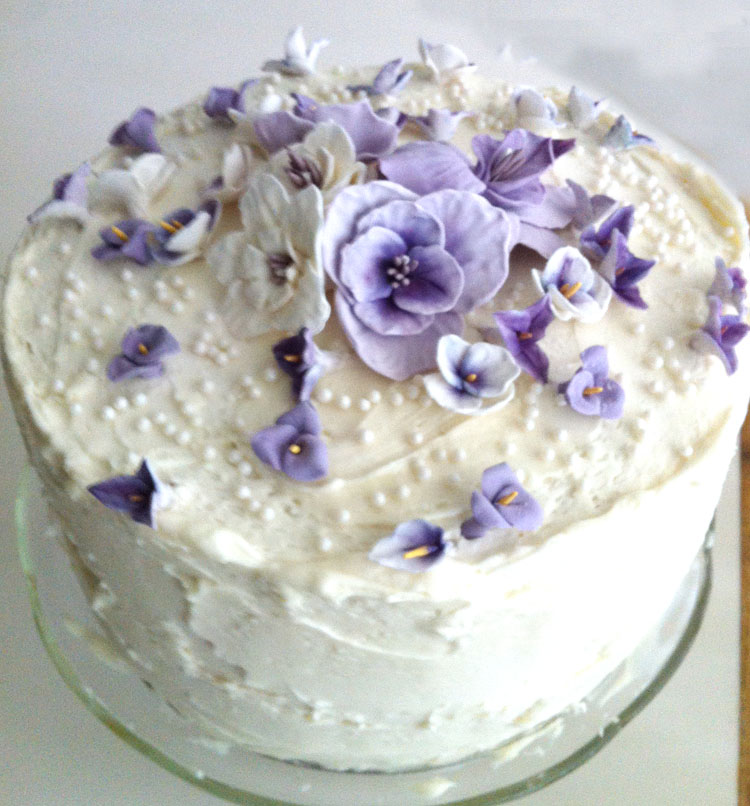
We had no official photographer, props, hair stylist, make-up. Nothing but the reason why we all were there. (I partially mention this in defense of my general appearance- I am no wizard with hair and makeup.) I also got a steal on my silk dress, and created and hand beaded my sash. Also in the DIY spirit, my talented mother made the 4 layered pound cake with chocolate ganache, raspberries and butter cream frosting. I sculpted the purple sugar flowers that decorated the top.

I forgot to take a real photo with my camera, so this iphone shot is the only photo I have.

The photographs are courtesy of my trusty Nikon D90, 50mm lens, my brother Steven, and his amazing wife Lizzy. I idolized my sister-in-law’s spirit as she quickly snapped hundreds of photos, running about and working for each and every frame. I noted that if I had an ounce of her general attitude and constant enthusiasm, I would be a much better photographer. Big thanks to all who made our day so special.

Our honeymoon was in the tropical paradise of the US Virgin Islands. We spent 5 luxurious days as total beach bums at the Ritz in St. Thomas.

I don’t know what I did to deserve such an amazing husband.

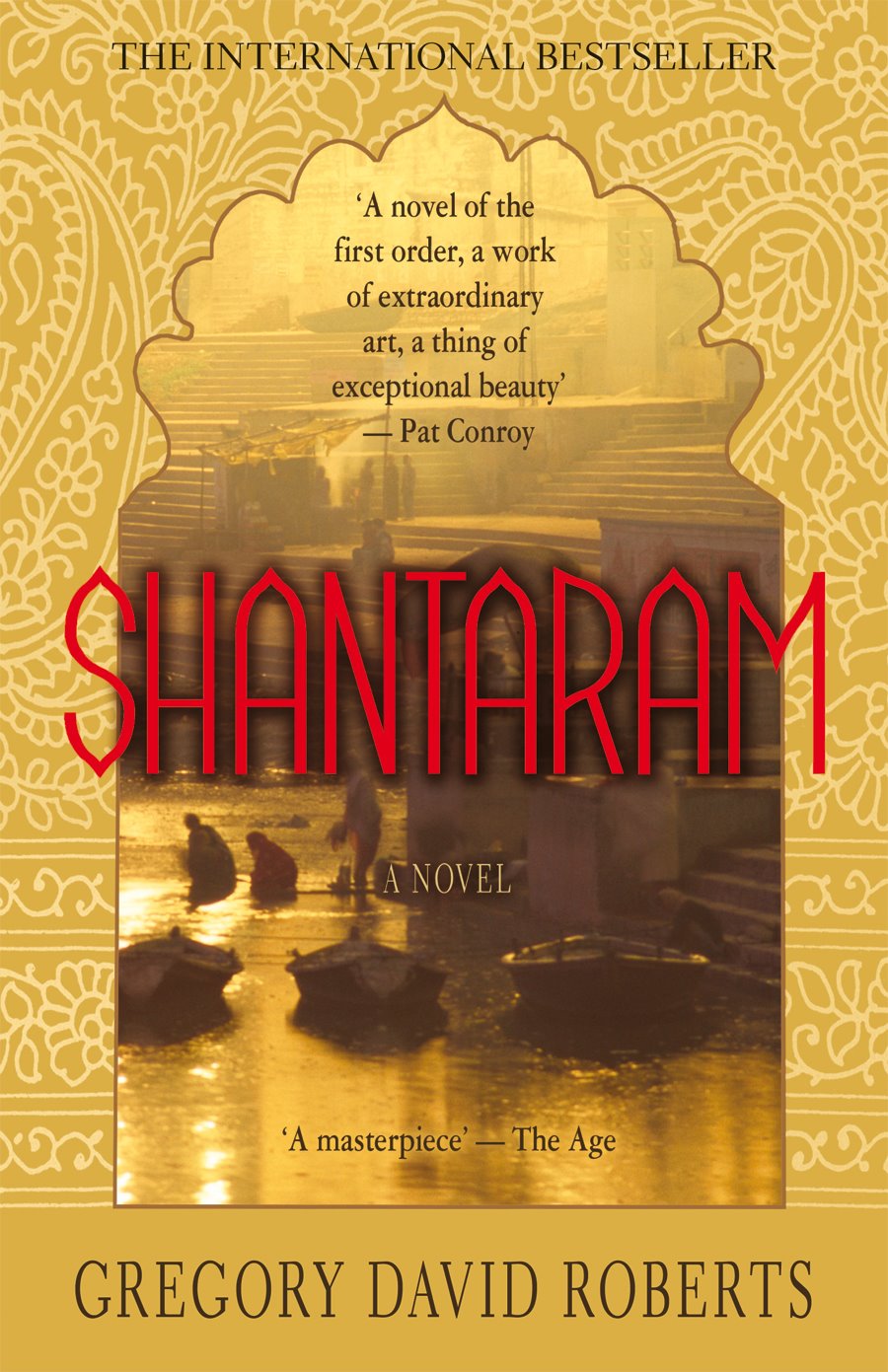
Shantaram: A Modern Odyssey

If the evolution of a name could ever be compared to the tale of the man, then Gregory, Lindsay, Lin, Linbaba, and Shantaram was the most beautiful metamorphosis.

“It was as good a name as any, and no more or no less false than the dozen others I’d assumed since the escape. In fact, in recent months I’d found myself reacting with a quirky fatalism to the new names I was forced to adopt, in one place or another, and to the new names that others gave me. Lin. It was a diminutive I never could’ve invented for myself. But it sounded right, which is to say that I heard the voodoo echo of something ordained, fated:  a name that instantly belonged to me, as surely as the lost, secret name with which I was born, and under which I’d been sentenced to twenty years in prison.”

Shantaram is an epic, autobiographical tale about a man who escapes from prison and begins a new life as a fugitive in Bombay. It’s a tale of a man who is desperate to keep his freedom at all cost, while trying to maintain and dissect the balance of right and wrong, good and evil seemingly in an effort to redeem his previous crimes. To make a living, Lin finds himself quickly immersed in the black market of India, an economical force that’s in close quarters with the law and politics. His tale takes him from the role as a beloved slum doctor to the thug life of a mafia brother, a life that directly challenges our moral presumptions and criminal profiles. That life gives creed to “doing the wrong thing for the right reasons,” a sort of criminal validation. With his band of brothers he falsifies and delivers documents, exchanges currencies, and eventually transverses mountains to fight in Afghanistan’s holy war. Each action, even war, is broken down into its parts, with heinous acts always justified by a larger, often simple belief.

Lin inadvertently builds himself up as a sort of God, which is never more evident than when he denounces praise and thanks. Bullets and murderous rages are abound in his Odyssey yet Lin remains. He helps the poor and is willing to fight another’s war for simply the love of a man. Shantaram, Lin’s adopted name, translates to ‘man of God’s peace.’ It’s a classic tale of trying to be everybody’s savior, while trying to save yourself.

Shantaram also weaves a love story with the classic, frustratingly shifted timeline, each lover trading roles in their unrequited love. The hero and narrator, Lin, also seems most invincible yet is surrounded by drama, loss and death- a trait that statistically seems unlikely for a biographical work and would barely survive fiction. The characters are dynamic with one of the best pieces of humor being a hug-able bear. The story also seems to grant its viewers with an unstudied portrait of Australia’s and India’s incarceration system. Those condemned as criminals suddenly seem far more innocent than their treatment by the wardens. Roberts creates an unexpected and sympathetic urge to free them all-to cheer on those who would be traditionally declared as ‘bad’ in most societies.

According to Robert’s personal record, he is eventually recaptured and serves the remainder of his sentence in prison back in Australia where he begins to transcribe his story. CNN hosted a special on Roberts, traveling with him to the real locations of his story, trying to sort through the truth and artistic liberties. It’s easy to be swept away in Roberts’s Odyssey and take away so many life lessons, but the betrayal of fiction amongst fact and its doubt has a way of sometimes deteriorating the message. But maybe that’s what faith is, and life is simply a fiction we write daily.

Shantaram is grossly entertaining in the least, and philosophically enlightening at its best. Like any good message, its quiet moments resonate deep within and its loud events bring forth a rush of emotions. It’s the type of book where you use a highlighter as your bookmark and dog-ear so many pages that its corners double in volume.

Dress Sketch

I’ll just come out and say it. One of the most exciting things about a wedding is the dress. It’s a time for total fantasy- something that only has to last one magical night. It’s an excuse to wear something truly classic and romantic, a chance that rarely comes twice.

Of course there’s also the location, the date, food, guest lists, decor, etc, but those are logistics, and I will pretend they don’t exist for now. For now all I see are creamy ivory silks, florence lace, sheer chiffon and pearl details.

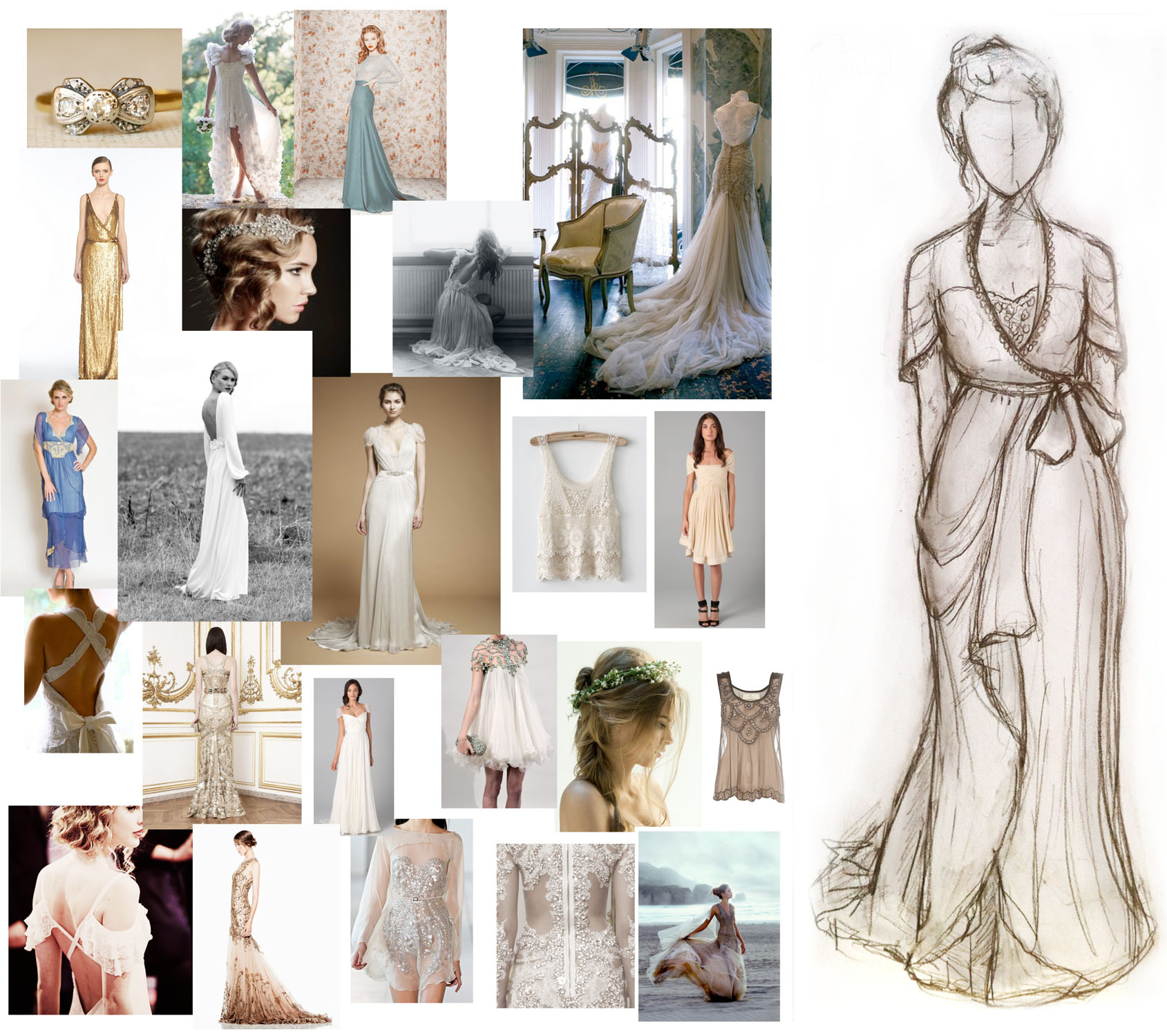
Thanks to pinterest, my ‘style’ board inadvertently leant itself well towards bridal gown inspirations. After pulling may favorite photos and details, I started sketching.

I’m not great at the 2D sort of creative endeavors. I prefer to just start draping fabric and see what happens. It helps to keep an open mind in terms of style when you have as limited technical sewing skills as I. For instance, the sleeves I sketched above can be draped horizontal or vertical, and I’ll probably do whichever is easier and looks better with the fabric I chose.

I’m naturally drawn to a vintage, classic extravagance- a retro mix of flowing, layered details and smart lines. Or to name a designer, Jenny Packman. The design must have sleeves and be flowy. I don’t think I could sew something that was tailored close to the body nor would a corseted sort of gown look good on me. I have also found beading to be quite relaxing and meditative, along with adding an easy sort of sophistication to a piece.

Thankfully I have a lot of time to sit and think, drape and cut. I often like to mentally sketch dresses for no reason at all, so this is a lovely excuse to daydream of silhouettes  and reinvented vintage flairs. I’m not a wedding nut by any means, but fashion- well, that’s just art.

Remote Photography

It’s quite magical and mysterious, taking a photograph without having someone behind the camera. When paired with a tripod, you can shoot your own portraits using the camera’s self timer, a cable release, shooting tethered to a computer or other device, or my new favorite and most modern approach- shooting with a wireless remote.

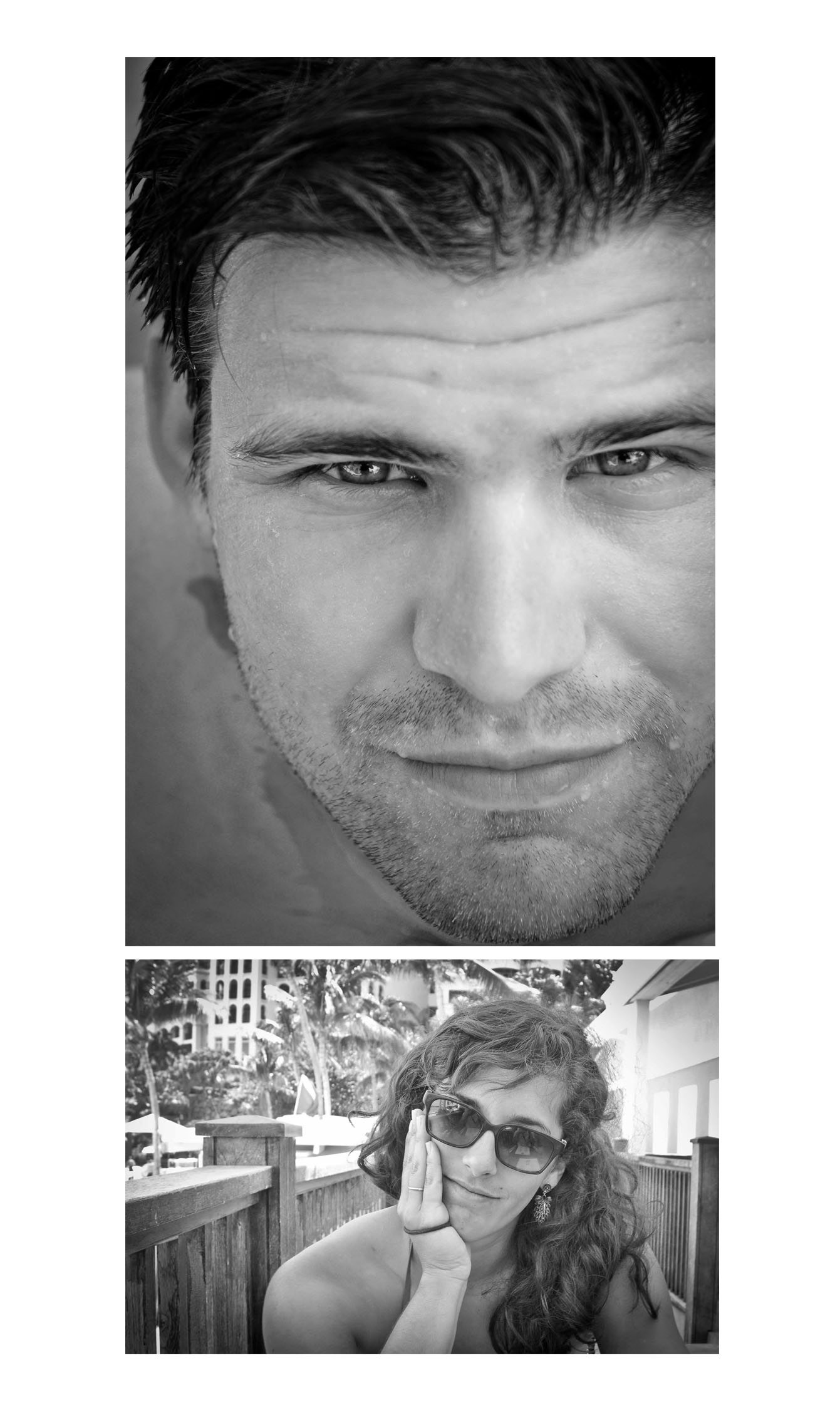
There’s no time to make your newly anointed fiancee partake in photos then post engagement celebrations. We’re both terribly awkward in front of the lens and would be even more so with an actual photographer, so we flew solo, just the two of us and a tripod, my trusty Nikon D90, and my new wireless remote (10$ from Amazon Basics). Oh wait, there was also the ever present Marshall.

I must admit, I was at first skeptical of my wireless remote when it was given to me as a Christmas present, assuming that it would be complicated and not compatible with my camera. However, using it couldn’t have been easier. It works with many DSLRs and only requires you change your shooting mode to ‘remote‘ which you do the same way as when you change your camera to a ‘self timer’ mode. The only slightly meddlesome part that must be creatively resolved is disguising the actual remote in your hand. It’s a small device, but if obscured too much, won’t trigger the shutter. My personal cheat and compromise was to simply crop out my hand.

Despite that, I still feel the wireless remote is far superior than a self timer being that there’s no running to and fro between the camera and scene. A necessity to the idea of shooting your own portrait is to shoot many, many frames, since you’re basically crossing your fingers and playing a numbers game. With the remote, you can click rapidly and not have to reset the timer. However, I still recommend taking a break to review your photos every 15 frames or so. The good news about all the bad frames is that at least there’s no third party to witness them!

Winter’s Tale

“There were fires blazing on every corner, mortal arguments on each block, robberies in commission, buildings attacked by squads of devilish wreckers, and buildings assembled by constructions workers who rode single cables until they disappeared into the sky. Hardesty found it difficult to get downtown and stay the same. The city wanted fuel for its fires, and it reached out with leaping tongues of gravity and flame to pull people in, size them up, dance with them a little, sell them a suit- and then devour them.”

Winter’s Tale by Mark Helprin is nearly impossible to describe. Indeed, it would take the author himself to give the right words, for to convey his standard of the English language, to show and convince you of his ability to manipulate the senses while turning you on your head- it would lead to self defeat. You would trip and stumble, desperately trying to give words to things that only Helprin can, envious of his powers. For to praise the author, you would want to do so in his own language.

A ‘Winter’s Tale’ is like nothing I’ve read before. Sometimes confusing and always quirky, you forget that you’re reading about a real place. It’s not the dangerous and inventive abstract art pitting itself against a classical precedent. It’s simply taking basic tools and mixing them together in ways that show entirely new colors. Helprin doesn’t just tell you that the sky is blue, that the ocean tasted of salt or that the ice was cold. He tells you that the frozen lake was ‘endless glass like an astronomer’s mirror, the monster’s sealed in tight…’ Even the most inanimate object or thing is alive, from the clouds to the earth beneath the city.

Helprin weaves you through the lives of many characters over the span of a single person’s lifetime, all threads slowly coming together in the way that gives creed to the phrase “It’s a small world.” The setting, indeed the heart of the story, is New York city. It’s about a New York city that breathes, kills, purrs, glows, and most importantly, molds. It can change you constantly, call to you, spit you out and welcome you back with open arms. It’s a city that you can hate and love, love then hate. The story seems to blend reality with fantasy, yet is simply hyper-realism. Helprin describes things and certain truths so eloquently that they appear too fantastical for reality but upon further inspection, is truth defined beyond it’s standard parameters.

With a normal book, to convince a friend to read it you would give away the first 3/4ths of the plot. This story is beyond plot and can be made testament to with a single sentence alone. Below are some of my favorite quotes from the first 1/2 of the book. Hopefully their poignancy isn’t lost when taken out of context. I believe that their universal message can stand alone. A man of the navy and Israeli Air force, Mark Helprin, much like Ernest Hemingway and countless others who are veterans, seem to have a unique grasp on life and language.

The city was like war- battles raged all around, desperate men were on the street in crawling legions. He had heard the baymen tell of war, but they had never said it could be harnessed, its head held down, and made to run in place.

When Peter Lake danced by the night fountain in the dark green square, and was given coins for his dancing, he became a thief.  Though it would take a long time for him to understand the principle, it was that to be paid for one’s joy is to steal.

“What’s money?” asked Peter lake.
“Money is what you give the monkey, or the monkey pee on you.” replied the organ-grinder.

Those who decided such things decided that whoever had seen the map has only imagined it, and the entire matter was forgotten, treated as if it were a dream, and ignored. This, of course, freed it to live forever.

The upper Hudson was as different from New York and its expensive baylands as China was from Italy, and it would have taken Marco Polo to introduce one to the other. If the Hudson were likened to a serpent, then the city was the head, in which were found the senses, expressions, brain and fangs. The upper river was milder, stronger, the muscular neck and smoothly elongated body. There was no rattle to this snake. Albany sometimes tried to rattle, but failed to emit an audible sounds. First of all, the Hudson landscape was a landscape of love. To reach it by sea, one had to have a series of  glorious weddings, crossing the sparkling bands that were the high bridges. The one sailed into tranquil, capacious, womanly bays, the banks of which were spread as wide and trusting as any pair of legs that ever were. Thus began an infinity of  pleasant convolutions.

“Despite their incapacities, these touching, persistent, third-rate-seventh-rate- theatrical people strove to excel. They thought they were artists: they said so on their tax forms and in bus stations in northeastern Delaware, and they almost had it right, for they were not artists, but art. They were in themselves like sad songs, or revealing portraits.”


Circa 1890s, In Photoshop

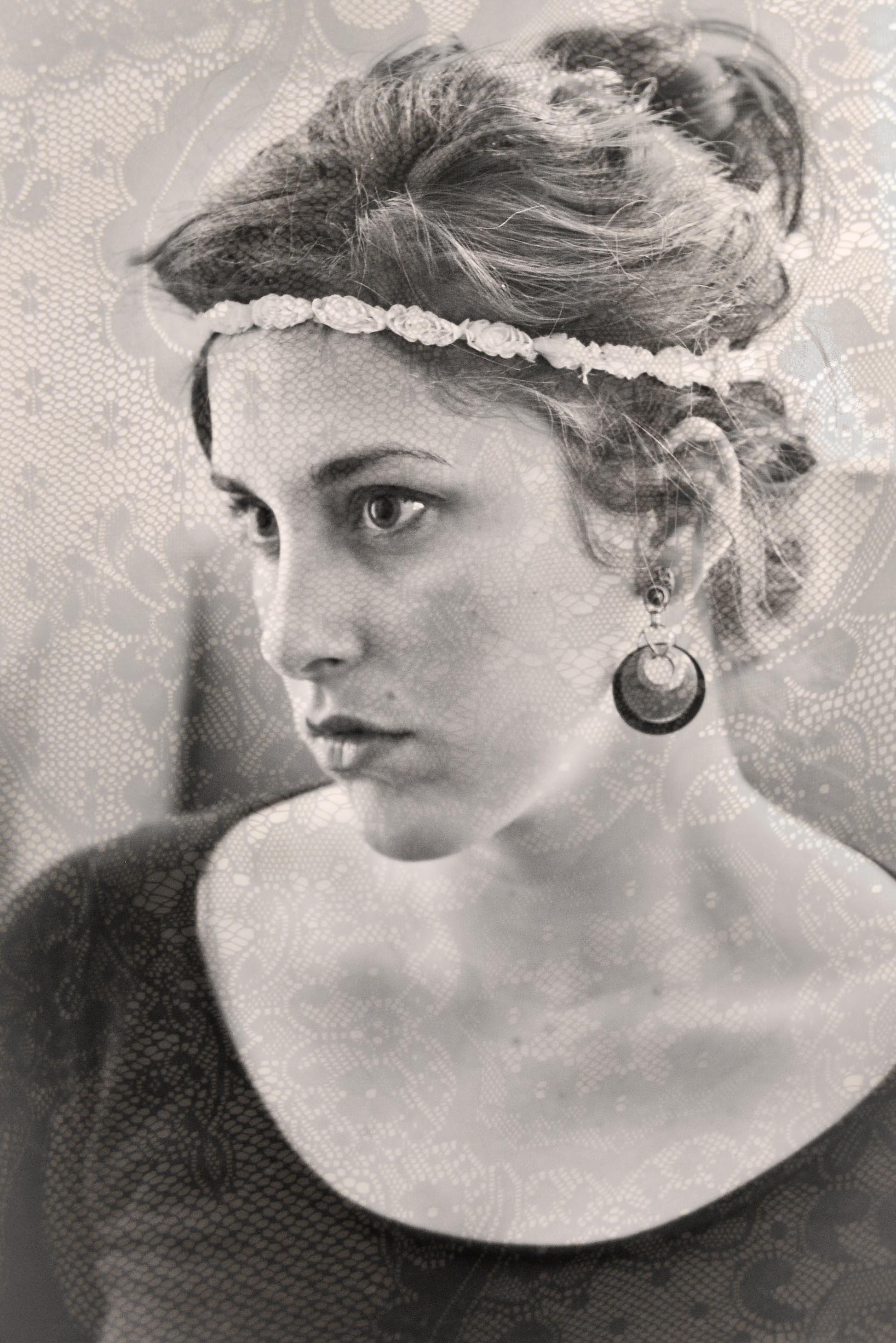
Heavy handed? Yes. Vintage photograph from way back when? No. I shot this photo yesterday, using a Digital SLR (Nikon D90 with 50mm 1.8 prime lens), a self-timer and late afternoon light softly diffused through linen curtains.

My original intention was to shoot some head-shots for work purposes while I had the apartment to myself. I am absolutely hopeless in front of the lens, further affirming my need to be behind the lens. It was an awkward 15 minute session, ushering my cat out of his beloved chair, racing against the light, focusing without a placeholder, and staring at a blinking timer light, grimacing as the shutter ‘clicked.’ After some desperate and disappointing shots, I decided to just- bah- do whatever and ended up with a shot that felt strangely ‘old.’ To see the photo fully realized, I decided to apply a heavy editing hand. I’m not a huge fan of over stylized looks, it seems like a betrayal to the original photograph, but, c’est la vie.  As long as each lie has a purpose, it can add up to a truth of sorts.

To achieve the photo above, I processed it in both Lightroom and Photoshop, but Lightroom wasn’t necessary, just easier for some things. Basically, I desaturated the photo, lightened the edges, evened out the shadows in the face, applied a weak yellow toned photo filter, and added another photo (layer) of a lace detail. For the ‘lace’ layer, I pulled the opacity down to 17 or so and erased certain areas using a weak brush. None of this is particularly difficult or masterful- I probably utilized .01% of photoshop to achieve this, so don’t let it sound intimidating.  If you want this look on the go, I’m sure there are Lightroom presets and Photoshop actions that achieve the same end.

Some other Photoshop ‘go to’s’ I like to use for portraits: Using a curves layer to ‘paint with light; using the clone stamp with a large brush and opacity around 12% to even and soften skin; and using ‘levels’ to enhance the dark tones.

“Photo credits”: Max Studio Black dress from TJMaxx ($15), Rosette headband from H&M ($4), and Clip earrings courtesy of my wonderful older sister.

Family Flavors

I don’t know how chefs put together cook books with hundreds of recipes. Just putting forty or so together took me months, between the layouts, cooking, and photographing. And of course, as soon as I went to print I found a few more typos. Oh well.

Blurb, the online custom printer I used, is a wonderful service that allows you to digitally preview the book and even place orders at print cost. So feel free to flip through the book or even purchase one (if you dare!).